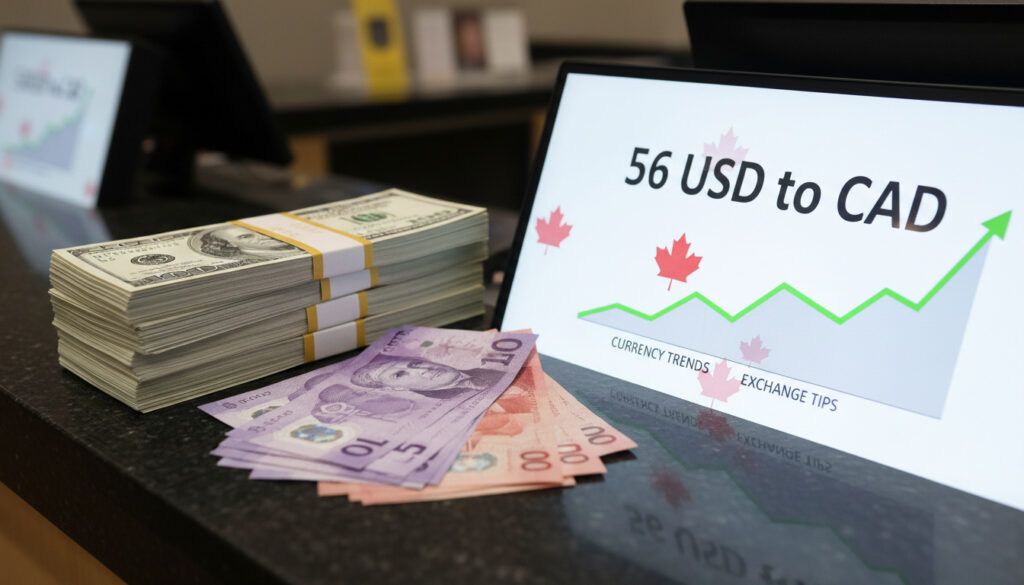
56 USD to CAD – Current Rate, Trends and Tips
Converting fifty-six United States dollars to Canadian currency currently yields approximately seventy-seven dollars and twenty-eight cents, based on prevailing mid-market exchange rates of 1.38 Canadian dollars per US dollar. This calculation reflects the real-time value of the currency pair without institutional markups or hidden conversion fees.
The USD/CAD pair has maintained relative stability over recent trading sessions, oscillating within a narrow band between 1.38 and 1.39. Understanding these fluctuations helps travelers, online shoppers, and cross-border businesses determine optimal timing for currency exchanges and budget accordingly for international transactions.
What is 56 USD to CAD Today?
- The mid-market exchange rate stands at approximately 1.38 Canadian dollars for every US dollar.
- Fifty-six US dollars converts to roughly seventy-seven dollars and twenty-eight cents CAD at current benchmarks.
- Over the past thirty days, the pair has appreciated by 0.19 percent, indicating modest US dollar strength.
- Volatility remains low, with the rate trading within a 1.7-cent range over the past month.
- Traditional banks typically offer rates 1-3 percent less favorable than mid-market benchmarks.
- The inverse conversion places one Canadian dollar at approximately seventy-two US cents.
- Ninety-day averages suggest a gradual upward trend for the US dollar against its Canadian counterpart.
| Metric | Value | Period |
|---|---|---|
| Mid-Market Rate | 1.38 CAD | Current |
| 56 USD Value | 77.28 CAD | Current |
| 30-Day High | 1.3903 CAD | Last 30 days |
| 30-Day Low | 1.3733 CAD | Last 30 days |
| 30-Day Average | 1.3793 CAD | Last 30 days |
| 7-Day Range | 1.3877 – 1.3946 | Last 7 days |
| 90-Day Average | 1.3720 CAD | Last 90 days |
| Inverse Rate | 0.72 USD | Current |
How to Convert USD to CAD
Currency conversion involves more than simple multiplication. The process requires understanding which exchange rate applies to your specific transaction, as retail rates often deviate significantly from interbank benchmarks used by financial institutions.
Understanding Mid-Market Rates
The mid-market rate represents the midpoint between the buy and sell prices for a currency pair on global markets. Wise and other transparent services use this rate as their baseline, displaying the real value of fifty-six US dollars at roughly seventy-seven Canadian dollars without embedded margins.
The mid-market rate is the real exchange rate without hidden fees or markups. It represents the exact midpoint between what buyers are willing to pay and sellers are willing to accept on global currency markets.
Bank Rates vs. Digital Services
Traditional financial institutions typically apply spreads ranging from one to three percent above the mid-market rate. This means converting fifty-six dollars through a major bank might yield only seventy-five Canadian dollars rather than the full seventy-seven, with the difference covering operational costs and profit margins.
On a fifty-six dollar conversion, a three percent bank spread costs approximately two dollars and thirty cents in hidden fees. For larger transactions, these differences compound significantly.
Exchange rates fluctuate continuously during trading hours. Executing a conversion when the rate hits the upper end of the daily range can yield an additional dollar or two on larger sums.
Current USD to CAD Exchange Rate Trends
Recent trading sessions have shown remarkable stability for the currency pair, with movements constrained within tight boundaries that suggest balanced market sentiment among foreign exchange traders.
Seven-Day Performance
Over the past week, the rate has oscillated between 1.3877 and 1.3946 Canadian dollars per US dollar, averaging 1.3921. This narrow 0.20 percent volatility indicates a consensus among traders regarding near-term valuation, according to XE currency data.
Thirty-Day Analysis
The monthly view reveals slightly broader movement, with the pair touching a high of 1.3903 and a low of 1.3733. The thirty-day average settled at 1.3793, representing a modest 0.19 percent appreciation for the American currency. This gradual strengthening suggests sustained confidence in US economic indicators relative to Canadian forecasts.
Quarterly Context
Extending the timeline to ninety days shows the exchange rate traversing a wider channel between 1.3574 and 1.3903. The quarterly average of 1.3720 and overall change of 0.94 percent indicate that while short-term volatility remains muted, longer-term trends favor the US dollar incrementally.
Recent Timeline of USD to CAD Movements
The following sequence tracks significant rate levels for the fifty-six dollar conversion amount over recent trading periods.
- Thirty-day peak: Fifty-six US dollars converted to 77.86 CAD at the monthly high of 1.3903.
- Thirty-day trough: The same amount yielded only 76.90 CAD when the rate dipped to 1.3733.
- Seven-day average: Conversions averaged 77.96 CAD based on the 1.3921 mean rate.
- Current benchmark: The present rate of 1.38 yields approximately 77.28 CAD for fifty-six dollars.
- Ninety-day baseline: Historical averages suggest a typical conversion value of 76.84 CAD.
Established Facts and Remaining Uncertainties
Clear distinctions exist between verified data points and projections that remain subject to market forces and policy decisions.
Confirmed Data
- Current mid-market rate: 1.38 CAD per USD
- 56 USD equals 77.28 CAD at current rates
- Thirty-day volatility: 0.19 percent change
- Seven-day trading range: 1.3877 to 1.3946
Uncertain Variables
- Future Bank of Canada interest rate decisions
- Near-term oil price fluctuations affecting CAD strength
- Specific bank fees for individual transactions
- Intraday rate movements beyond current snapshots
Economic Context Behind the Exchange Rate
Multiple macroeconomic factors influence the relative value of American and Canadian currency. Interest rate differentials between the Federal Reserve and Bank of Canada create yield incentives that drive capital flows across the border. For a deeper understanding of how market forces and policy decisions influence currency values, explore the Russell 2000 Index.
Commodity prices, particularly crude oil, significantly impact the loonie’s purchasing power. As a major petroleum exporter, Canada’s currency typically strengthens when energy markets rise and weakens during downturns. Trade dynamics between the two nations, governed by agreements and tariff structures, further affect exchange rate pressures through balance-of-payments mechanisms.
Shoppers monitoring Black Friday Deals Canada often track these rates closely, as a stronger US dollar increases the effective cost of American goods for Canadian consumers. Those seeking assistance with cross-border purchases may consult Amazon Canada Customer Service for guidance on international transactions.
Data Sources and Methodology
Rate calculations derive from aggregated market data provided by leading financial information services and central banking institutions.
The mid-market rate stands at approximately 1.38 to 1.39 Canadian dollars per US dollar, representing the real exchange rate without markups.
— Wise Currency Converter
Over the last seven days, USD to CAD has traded between 1.3877 and 1.3946, with an average of 1.3921 and 0.20 percent volatility.
— XE Currency Data
Additional verification comes from the European Central Bank reference rates and institutional forex data.
Summary
Fifty-six US dollars currently converts to approximately seventy-seven dollars and twenty-eight cents Canadian, based on a mid-market rate of 1.38. While thirty-day trends show modest appreciation for the US currency, the pair remains range-bound with low volatility. For those converting funds, choosing services that honor mid-market rates rather than traditional bank spreads can preserve an additional one to three percent of value. Monitoring resources like XE’s currency converter helps track optimal timing for transactions.
Frequently Asked Questions
How much is 56 USD in CAD today?
At current mid-market rates of 1.38, fifty-six US dollars equals approximately seventy-seven dollars and twenty-eight cents Canadian.
Why do banks offer different rates than online converters?
Banks embed operational costs and profit margins into their exchange spreads, typically offering rates one to three percent below mid-market benchmarks.
Is the Canadian dollar expected to strengthen against the US dollar?
Currency forecasting remains uncertain. Factors include Bank of Canada interest rate policies, oil price movements, and trade balance dynamics.
What is the inverse conversion for 56 CAD to USD?
At the current inverse rate of 0.72, fifty-six Canadian dollars converts to approximately forty dollars and thirty-two cents.
How often do USD to CAD exchange rates change?
Rates fluctuate continuously during forex market hours, though the magnitude of change varies daily based on economic news and trading volume.
What was the highest rate for 56 USD in the last 30 days?
The thirty-day high of 1.3903 would have converted fifty-six dollars to seventy-seven dollars and eighty-six cents Canadian.
Do exchange rates vary between Canadian cities?
Mid-market rates remain consistent globally, though retail rates at physical exchange bureaus may vary by location and provider.
More related posts
 Robert Trujillo: Biography, Net Worth & Career Facts
 Violet Myers: Career Status, Personal Life, and FAQs
 Kris Kristofferson: Death, Illness, and Legacy of the Country Legend
 Amanda Peterson: Career, Net Worth, and Cause of Death
 Oliver Haarmann: Net Worth, Age, and Reese Witherspoon
 Hunger Games: Sunrise on the Reaping – Release Date & Plot
 Cade Cunningham Collapsed Lung: Injury, Height & Contract
 Jules Ari: Age, Ethnicity, Biography, Verified Facts