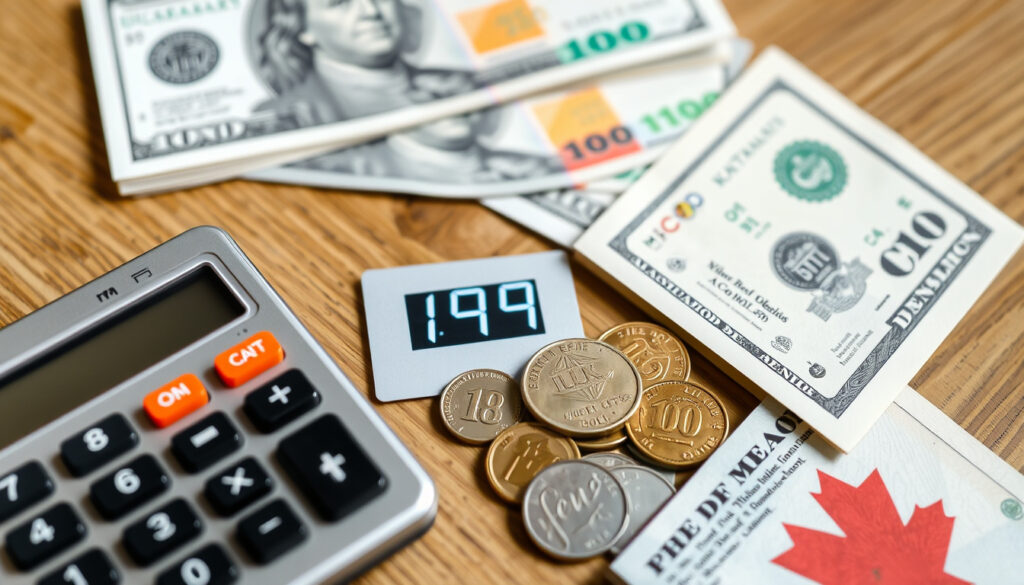
199 USD to CAD – Convert US Dollars to Canadian Dollars
You’ve got 199 US dollars and you’re wondering what that means in Canadian dollars—maybe you’re planning a trip, sending money, or just curious. The number sounds simple enough, but the real-world answer depends on where you exchange your cash, how fees stack up, and even which bills you’re holding.
1 USD to CAD (mid-market rate): 1.36 CAD ·
199 USD to CAD (as of 17 Mar 2025): 270.59 CAD ·
Minimum tipping in Canada: 15% of the bill ·
$1000 CAD bill discontinued: 2000
Quick snapshot
- 1 USD = 1.36 CAD (mid-market) (Xe.com (currency data provider))
- 199 USD = 270.59 CAD (CurrencyRate Today (live conversion tool))
- Interest rate differentials (Investopedia (financial reference))
- Commodity price dependence (Investopedia)
- Economic performance gap (Bank of Canada (central bank rate source))
- 15-20% is standard (Lonely Planet (travel guide))
- $20 tip is generous for moderate bills (Frommer’s (travel guide))
- $1000 bill discontinued in 2000 (Bank of Canada (central bank))
- $2 bill can be worth up to $20,000 (Bank of Canada (bank notes overview))
Five key numbers, one takeaway: the mid-market rate gives you a clean baseline, but every provider adds its own margin.
| Label | Value |
|---|---|
| 1 USD = | 1.36 CAD |
| 199 USD = | 270.59 CAD |
| Minimum tip | 15% |
| $1000 bill legal to own | Yes, but not spendable |
What’s $100 USD to CAD?
Knowing what $100 US dollars buys in Canada is a practical starting point for any conversion from USD to CAD. The mid-market rate puts it at about 136 Canadian dollars, but when you convert $199, the same math scales up.
Current exchange rate for 100 USD
- 1 USD equals approximately 1.36 CAD (Xe.com (currency data provider))
- 100 USD equals 136 CAD
- At the Bank of Canada’s daily fixing, the rate is published by 16:30 ET (Bank of Canada (central bank rate source))
Comparing 100 USD to 199 USD conversion
The pattern is linear: $100 = 136 CAD, $199 = 270.59 CAD (from CurrencyRate Today (conversion tool)). But real-world rates vary by provider. Wise shows 199 USD ≈ 279 CAD with a 30-day average of 1.3881 (Wise (digital money transfer)), while Revolut quotes 278.38 CAD (Revolut (multi-currency platform)).
The implication: knowing the mid-market rate is just the start; the actual amount you receive depends on the service you choose.
Why is CAD so weak against USD?
The Canadian dollar has been trading above 1.40 per USD in recent months. Three structural reasons explain the gap.
Economic factors behind the weak Canadian dollar
- Interest rate differentials: The Bank of Canada’s key rate has stayed lower than the US Federal Reserve’s, making USD-denominated assets more attractive (Investopedia (financial reference)).
- Commodity prices: Canada’s economy leans heavily on oil and minerals; when prices dip, CAD falls (Bank of Canada (central bank rate source)).
- Relative economic performance: US GDP growth has outpaced Canada’s, reinforcing the greenback’s strength.
Impact on travelers and shoppers
For American visitors, a weaker CAD means your 199 USD stretches further—you get more Canadian dollars per dollar. But Canadians shopping across the border feel the pinch because everything is effectively 36% more expensive.
For a US traveler spending $199 USD, the weaker CAD buys about 271 CAD instead of the 199 they’d get at parity. That extra 72 CAD matters for hotel nights and meals. But the same weakness makes Canadian goods cheaper for American importers.
What this means: The Canadian dollar’s weakness is not a short-term blip but a reflection of structural economic differences.
Is $20 CAD a good tip?
Canadians tip on pre-tax bill amounts, and the standard range is 15-20% at full-service restaurants. So whether $20 CAD is generous or skimpy depends on the bill total.
Tipping etiquette in Canada
- Restaurants: 15-20% on pre-tax total (TripAdvisor (travel advice)).
- Taxis and rideshares: 10-15% (Lonely Planet (travel guide)).
- Hotels: $2-5 CAD per bag for porters, 15-20% for housekeeping (Condé Nast Traveler (travel publication)).
- No tipping required at fast food or self-service (Frommer’s (travel guide)).
How much to tip for different services
If your dinner bill is $60 CAD, 15% = $9, 20% = $12. A $20 CAD tip on that bill would be over 33%—very generous. But on a $150 CAD meal, $20 is just under 15%, slightly below standard. The rule: adjust to the total, not a flat amount.
For American visitors converting 199 USD to about 271 CAD, a $20 CAD tip is roughly $14.70 USD. It’s easy to overtip if you think in US dollars—check the local currency before you leave the tip.
The catch: Tipping in Canada requires mental currency conversion if you’re used to US dollars.
Is it illegal to own a $1000 Canadian bill?
Canada’s $1000 bill was withdrawn from circulation in 2000, but owning one is perfectly legal—you just can’t spend it at face value anymore.
Legal status of high-denomination Canadian bills
- The Bank of Canada withdrew the $1,000 note from circulation effective 2000 (Bank of Canada (central bank)).
- It is not illegal to own or hold the note (Bank of Canada).
- However, it is no longer legal tender for transactions—businesses are not obligated to accept it.
Are $1000 bills still in circulation?
Very few remain in private hands. The bank stopped distributing them decades ago, and most have been turned in or destroyed. Collectors now trade them above face value.
If you own a $1000 Canadian bill, you can’t deposit it at face value at most banks—they’ll send it to the Bank of Canada for verification. The process can take weeks, and you’ll get the equivalent in smaller denominations.
The pattern: While legal to own, these bills are essentially museum pieces for modern transactions.
How much is a $1000 Canadian dollar worth?
At today’s exchange rates, $1000 CAD converts to roughly $735 USD. But a physical $1000 banknote may be worth much more to collectors. For more information on this, you can check out the Aplicació del pla dental del Canadà. Aplicació del pla dental del Canadà
Value of a $1000 CAD bill in USD
- Using 1 USD = 1.36 CAD, $1000 CAD = $735 USD (Xe.com).
- Currency market fluctuations can shift that number by $10-20 USD in a week.
Collectible value beyond face
Certain series of the $1000 bill, especially the 1954 “Devil’s Face” issue, sell at auction for $2,000-5,000 CAD depending on condition. The $2 bill, meanwhile, can fetch up to $20,000 CAD in pristine uncut sheets (Bank of Canada).
The pattern: face value is the floor. For rare banknotes, the premium comes from scarcity, condition, and series, not the denomination.
Four services, one decision: where you convert matters.
| Provider | Rate for 199 USD | Fees (typical) | Best for |
|---|---|---|---|
| Wise | ~279 CAD | 0.4-1% of amount | Digital transfers, low fees (Wise) |
| Xe.com | ~271 CAD | 0% (market rate) | Checking rates, no transfer (Xe.com) |
| Revolut | ~278 CAD | 0% (within limits) | Card spending abroad (Revolut) |
| US Bank branch | ~265-270 CAD | 2-5% markup | Immediate cash, convenience (NerdWallet (personal finance)) |
Upsides
- Mid-market rates are transparent and easy to find online
- Digital services like Wise lock in rates for a few seconds
- ATMs in Canada give better rates than bank tellers
Downsides
- Banks often add 2-5% margin on top of the rate
- Currency conversion at airport kiosks is the worst deal
- Some digital services have daily limits or monthly caps
Confirmed facts
- Current exchange rate from mid-market sources: 1 USD = 1.36 CAD (Xe.com)
- Legal status of $1000 bill per Bank of Canada: legal to own, not spendable
- Tipping standards in Canada: 15-20% at restaurants (TripAdvisor)
What’s unclear
- Future exchange rate predictions—markets are volatile and no one can forecast precisely
- Exact collectible value of old bills—varies by series, condition, and auction demand
- Exact conversion rate at physical bank branches—varies by branch and day
“The $1,000 bank note was withdrawn from circulation in 2000. It is not illegal to own one, but it is no longer legal tender for transactions.”
Bank of Canada (central bank authority, on the legal status of high-denomination notes)
“In Canada, a 15-20% tip on the pre-tax bill is standard at sit-down restaurants. For taxis, 10-15% works. Leave a few dollars per bag for porters.”
Lonely Planet (travel guide, on tipping customs)
For an American visitor carrying 199 USD, the single most important step you can take is to avoid exchanging cash at your hotel or a US bank branch. Use an ATM once you land in Canada, or a digital service like Wise to lock in the mid-market rate. That choice alone can save you 4-6%—enough to cover a generous tip on a nice dinner. For the traveler heading north, the decision is clear: check the live rate, choose a low-fee provider, and let the weak Canadian dollar work in your favor.
Related reading: USD to CAD conversion guide · tipping in Canada
ex-rate.com, currencyconvert.online, canamcurrencyexchange.com
For a similar conversion, you can check the 153 USD to CAD conversion guide for another common amount.
Frequently asked questions
How much is $1 USD to CAD?
As of mid-March 2025, $1 USD equals approximately 1.36 CAD at the mid-market rate, according to Xe.com.
How much is a $20 bill from Canada worth in the USA?
A $20 CAD banknote is worth about $14.70 USD at current exchange rates (1 CAD = 0.735 USD). The physical bill itself may carry collectible value if it’s a rare series.
What is € 1 to 1 Canadian dollar?
As of March 2025, €1 equals roughly 1.48 CAD. For EUR to CAD conversion, check a live converter like Xe.com.
How much is a 1937 Canadian $20 bill worth?
A 1937 $20 note can range from $40 to $200 CAD depending on condition and series, according to banknote collector guides. Uncirculated examples fetch higher prices.
Is a $2 Canadian bill worth $20,000?
Most circulated $2 bills are worth $2-10 CAD, but uncut sheets and rare error notes can sell for up to $20,000 CAD at auction, per Bank of Canada references.
More related posts
 Translate English to Italian: Tools, Phrases, Slang
 Caitriona Balfe: Biography, Age, Baby, and Sam Heughan
 South Africa vs Cameroon: CAN 2025 Result & Travel Guide
 Gary Sinise: Son’s Death, Acting Career, Family & Politics
 Martina Navratilova: Cancer Diagnosis, Wife Julia, Net Worth
 Morena Baccarin Biography: Age, Children, Career & More
 Annie Guthrie: Poet, Jeweler & Family Updates