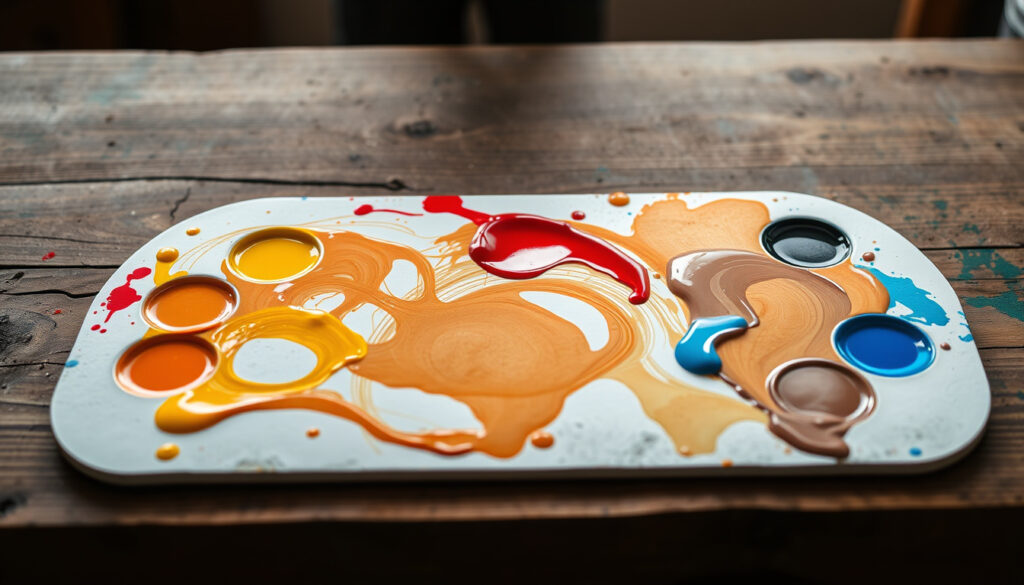
What Colors Make Brown – Mixing Guide with Ratios
Brown appears everywhere in nature—from tree bark to autumn leaves—yet creating it on a palette surprises many artists. The answer lies in understanding how colors interact, whether mixing two hues or combining all three primaries. This guide explains exactly which colors produce brown, how ratios affect the final shade, and what to expect when working with different media.
Unlike pure hues such as red or blue, brown exists as a tone—essentially a desaturated orange, red, or yellow. Its warmth or coolness depends on the specific pigments involved and their proportions. Artists have relied on these principles for centuries, and the same color theory that guided Renaissance painters applies today in studios and digital workspaces alike.
What Two Colors Make Brown?
Two complementary colors mixed together produce brown because they sit opposite each other on the color wheel. When opposing hues combine, they cancel out each other’s intensity through a process called chromatic cancelation, resulting in a muted, natural brown rather than gray or black.
The fastest two-color routes to brown are orange plus blue, red plus green, or yellow plus purple. Each pair sits opposite on the wheel, making them complementary combinations that desaturate toward neutrality.
Common Two-Color Pairs
- Orange + blue: The classic complementary pair for warm browns
- Red + green: Meets at brown via the color wheel midpoint
- Yellow + purple: Works when biased toward orange tones
- Orange + black: The simplest method—just darken orange
The pair you choose depends on what you already have on your palette. If orange sits mixed and waiting, adding blue gets you brown in seconds. For red and green painters, that combination yields the same result through a different route.
Why Complementary Colors Work
Complementary colors function as visual opposites. Red opposes green, yellow opposes purple, blue opposes orange. When opposite hues meet, their visual tension neutralizes—similar to how positive and negative numbers cancel mathematically. Imperfect pigments in real paints prevent this from producing pure gray, instead biasing the result toward brown. This phenomenon, documented by color theorists including Josef Albers, explains why complementary pairs universally yield earth tones.
Warm neutral brown
Medium earth brown
Golden umber tone
True neutral brown
- Brown forms when complementary colors cancel chromatic intensity
- Imperfect pigments bias results toward brown rather than gray
- Orange plus black represents the simplest two-color method
- Equal complementary proportions create neutral brown
- Unequal proportions shift warmth or coolness
- Greenish yellow and bluish purple together may yield gray instead
| Combination | Result Shade | Medium |
|---|---|---|
| Orange + Blue | Warm brown | Paint |
| Red + Green | Medium brown | Paint |
| Yellow + Purple | Golden brown | Paint |
| Orange + Black | Dark brown | Paint / Digital |
What Primary Colors Make Brown?
The three primary colors in traditional painting—red, yellow, and blue—combine to create brown when mixed together. This forms the foundation of the RYB (red-yellow-blue) color model used by artists for centuries. Equal parts of each primary produce a neutral brown, though real-world results vary based on pigment strength and specific hues chosen.
Red Yellow Blue Mixing
When red, yellow, and blue come together in equal proportions, they create what artists call a neutral brown. This happens because the three primaries together desaturate each other completely, similar to how complementary pairs work. However, the outcome depends heavily on which specific red, yellow, and blue pigments you select. A cool red like Alizarin Crimson combined with a warm yellow and deep blue produces different results than Cadmium Red, Hansa Yellow, and Cerulean Blue.
Pigment strength also matters significantly. Blue pigments tend to be weaker than reds and yellows, meaning blue easily gets overwhelmed in the mix. This natural imbalance often results in brown rather than black—even when mixing all three primaries intensely.
Adjusting Ratios for Shades
Ratios determine the specific shade of brown you achieve. Starting with equal parts red, yellow, and blue gives a basic neutral brown. Adjusting those proportions shifts the tone:
- 1:1:2 (Red:Yellow:Blue): Extra blue darkens the mix toward grayish brown
- 2:2:1 (Red:Yellow:Blue): More red and yellow creates warm reddish-brown
- Equal parts with white added: Lightens to tan or beige tones
- Extra blue with less red: Produces cool, muted browns
These ratios are approximate starting points. Actual results depend on pigment brand, age, and specific hue choices. Always test on your palette before committing to a large area.
| Base Mix | Ratio (R:Y:B) | Result Shade |
|---|---|---|
| Equal primaries | 1:1:1 | Neutral brown |
| Extra blue | 1:1:2 | Dark brown |
| More red/yellow | 2:2:1 | Warm brown |
| Primaries + white | 1:1:1 + tint | Light brown |
How Do You Make Brown with Paint?
Creating brown with traditional paints follows predictable steps, though the medium matters. Acrylic and oil paints respond similarly to color mixing, but drying time and pigment suspension differ. Digital artists work with RGB values instead of physical pigments, requiring a different approach entirely.
Step-by-Step Paint Mixing
Begin with small amounts of each color on your palette—smaller than a pea for initial tests. Mix thoroughly with your palette knife before assessing the result. If the mixture appears too warm, add tiny amounts of blue to cool it. If too cool, introduce more red or yellow. Building gradually prevents overshooting your target shade.
Work on a neutral gray or white surface when evaluating color. Colored backgrounds distort perception and make accurate mixing difficult. Natural daylight provides the most reliable color assessment, as artificial lighting varies in warmth.
Tips for Acrylic vs Oil
Acrylics dry quickly, so mix larger batches upfront if covering substantial areas. Oil paints allow extended working time, enabling gradual adjustments during mixing. Both media respond identically to the same color theory principles, but acrylic’s fast drying means decisions must happen faster. Oil painters can scrape back and remix repeatedly, though this requires more medium and extended drying between sessions.
Transparent pigments mix differently than opaque ones. Ultramarine blue, being transparent, produces darker results than equal proportions of Cerulean blue. Test each pigment individually to understand its strength before calculating ratios.
How to Make Different Shades of Brown?
Brown encompasses a vast spectrum—from nearly black espresso to pale cream. Each shade requires specific adjustments to the base mix. Understanding how to manipulate value (lightness/darkness) and saturation (color intensity) opens the full range of brown possibilities.
Dark Brown Recipes
Darkening brown involves adding its complementary color or using black strategically. Adding blue to the base mix pushes brown toward grayish darkness. Adding black darkens directly but risks muddiness if overused. The most natural dark browns often come from additional blue or complementary additions rather than pure black.
Another approach uses complementary pairs: continue adding orange to blue-brown, or red to green-brown. Each addition darkens incrementally while maintaining color harmony. This method preserves depth better than straight black additions.
Light Brown Adjustments
Lightening brown requires adding white or a pale tint. Titanium white works well for maintaining color clarity. Alternatively, desaturating yellow or orange toward beige creates naturally warm light browns without white’s potential flattening effect.
Starting with a pale base and adding tiny amounts of brown achieves soft tans and beige tones smoothly. This approach often produces cleaner results than lightening a dark brown through sheer addition.
- Add black or blue for deep espresso tones
- Continue complementary additions for natural darkening
- Add white for tan, beige, and cream variations
- Desaturate orange/yellow for warm light browns
- Warm primaries with cool primaries create mid-tone complexity
Do Complementary Colors Make Brown?
Complementary colors make brown through a process called chromatic neutralization. This principle sits at the heart of color theory and explains why opposing hues desaturate rather than gray out when mixed. The effect works consistently across all complementary pairs, though results vary based on specific pigment choices.
Color Wheel Basics
The traditional color wheel arranges hues in a circle: red, orange, yellow, green, blue, and purple. Complementary pairs sit directly opposite—180 degrees apart. This positioning creates maximum visual contrast, and when mixed, maximum desaturation. The wheel emerged from Isaac Newton’s experiments in the 1660s, though artists like Johannes Itten later formalized its application to mixing practice.
Examples in Practice
Blue and orange mixed together produce warm browns ranging from saddle to raw sienna depending on proportions. Red and green yield reddish-brown earth tones. Yellow and purple create golden-brown umbers. Each pair’s specific bias—warmer or cooler—determines the final result.
The relationship between complementary colors resembles mathematical cancellation. When equal intensities meet, they neutralize completely. Unequal proportions leave traces of the dominant color, shifting the brown toward warmth or coolness accordingly.
Perfect chromatic cancellation requires theoretically pure pigments. Real-world paints contain impurities and variations that prevent true neutralization. Instead of gray, we get brown—adding character and warmth to the mix rather than flat neutrality.
Understanding Color Theory
Color theory provides the framework for understanding why brown forms from specific combinations. Two primary systems govern color mixing: additive mixing (light-based, used for digital screens) and subtractive mixing (pigment-based, used for paints). Each system produces brown differently.
Subtractive mixing dominates traditional art. When pigments absorb certain light wavelengths and reflect others, the combination of multiple pigments removes more wavelengths, eventually approaching neutral. Adding all three primaries absorbs most light, reflecting only brownish wavelengths.
Digital color, by contrast, works additively through light emission. Screens create brown by using low-intensity red and green together, with blue absent or minimal. The RGB value RGB(165,42,42) produces saddle brown—essentially a desaturated, darkened orange displayed through light rather than pigment.
What the Research Shows
Color theorists and artists consistently confirm that complementary pairs and primary combinations produce brown. Studies of historical paintings reveal artists understood these principles centuries before formal color theory existed. Renaissance masters mixed browns from earth pigments, while modern artists manipulate synthetic pigments using the same foundational rules.
Color is never seen as it really is. It takes constant practice to see color relationships rather than isolated colors.
— Josef Albers, Interaction of Color
Sources across art education, color science websites, and practical artist communities converge on the same core principles. While exact shade results vary based on specific pigments and proportions, the fundamental mechanism—complementary desaturation producing brown—remains consistent across centuries and media.
Summary
Brown emerges from color mixing through complementary cancellation or primary combination. Orange plus blue, red plus green, or yellow plus purple each produce brown when mixed. All three primaries together—red, yellow, and blue—also yield brown, with specific shades controlled through ratio adjustments. Dark browns require additional blue or complementary additions; light browns need white or desaturation. Real-world pigments never perfectly neutralize, biasing results toward warm brown rather than neutral gray. Understanding these principles equips artists to mix browns confidently across any medium.
What does red and green make when mixed?
Red and green make brown. These complementary colors sit opposite each other on the color wheel, and their combination desaturates toward neutrality, producing an earth-tone brown rather than gray.
What is the best ratio for primary colors to make brown?
Equal parts red, yellow, and blue (1:1:1 ratio) create a basic neutral brown. Adjusting this ratio shifts the shade—more blue darkens toward grayish brown, while more red or yellow warms the result.
How do you make dark brown with paint?
Add extra blue to your base brown, or continue adding orange to a blue-brown mix. Adding black works but risks muddiness. Blue and complementary additions typically preserve better depth than straight black.
Can you make brown with only two colors?
Yes. Complementary pairs—orange and blue, red and green, or yellow and purple—each produce brown when mixed together. Orange plus black also creates dark brown as the simplest two-color method.
What colors make light brown?
Light brown results from adding white or titanium white to base brown, or by desaturating orange/yellow toward beige tones. Starting pale and adding small amounts of brown often achieves cleaner light browns than lightening a dark mixture.
Does yellow and purple make brown?
Yellow and purple can make brown, but the result depends on their specific hues. Yellow-green mixed with bluish purple tends toward gray. Yellow-orange mixed with red-purple (magenta) produces brown more reliably.
Why do complementary colors make brown instead of gray?
Perfect gray requires theoretically pure pigments that don’t exist in practice. Real-world pigments contain impurities and biases that warm their neutral results, pushing them toward brown rather than true gray.
How do digital artists create brown?
Digital browns use RGB values—low-intensity red and green together without blue. Adjusting saturation and hue sliders in software achieves various brown shades without the pigment limitations of physical media.
More related posts
 Sid Wilson: Condition, Relationship with Kelly Osbourne
 Cade Cunningham Collapsed Lung: Injury, Height & Contract
 Brandon Ingram: Injury, Personal Life, Stats, and Contract
 How to Clean Wood Furniture Properly: Safe Step-by-Step Guide
 Gary Sinise: Son’s Death, Acting Career, Family & Politics
 Jerome Powell: Accusations, Net Worth, Salary, and Trump Feud
 Charithra Chandran: Ethnicity, Net Worth, Bridgerton Exit
 Lorenzo Lamas: Net Worth, Sobriety, Career & Family