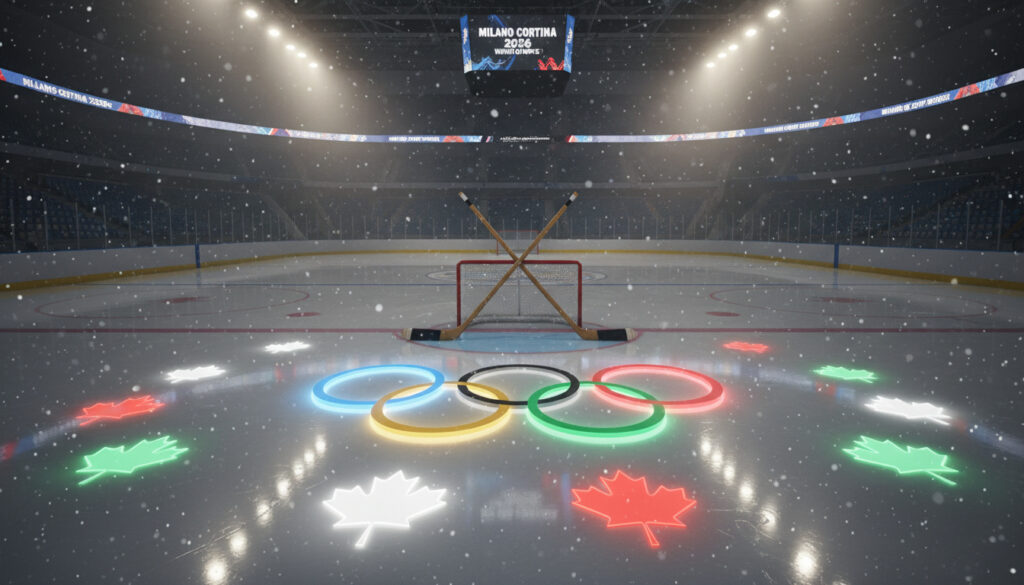
Canada Olympic Hockey Team 2026 – Confirmed Stars, Predictions, Timeline
Canada will enter the 2026 Milano Cortina Winter Olympics with a roster blending generational superstars and emerging talent, as Hockey Canada confirmed six foundational players including Connor McDavid, Sidney Crosby, and Cale Makar for the men’s ice hockey tournament. The composition of the remaining 19 roster spots remains under active evaluation by general manager Doug Armstrong, with final selections expected to balance Olympic experience against the rising momentum of young NHL stars. Tournament play begins February 6, 2026, marking Canada’s first Olympic appearance with full NHL participation since the 2014 Sochi Games.
The projected roster structure consists of 14 forwards, 8 defensemen, and 3 goaltenders, expanding from the 23-player format used during the 2024 4 Nations Face-Off tournament. This larger roster allows for additional specialization and injury coverage during the compressed Olympic schedule.
Selection debates currently center on whether Hockey Canada will prioritize established veterans or integrate teenagers like Connor Bedard and Macklin Celebrini, whom analysts project as having played their way onto the team through elite offensive production. Goaltending remains the least defined component of the roster, with no netminder yet confirmed among candidates including MacKenzie Blackwood and Logan Thompson.
Top Candidates for Canada’s 2026 Olympic Hockey Roster
Confirmed via 2024 agreement
6 of 25 roster spots filled
14 forwards, 8 defensemen, 3 goalies
Final roster due January 2026
- Six roster locks confirmed: Connor McDavid, Sidney Crosby, Nathan MacKinnon, Sam Reinhart, Brayden Point, and Cale Makar have secured positions according to roster projections.
- Projected super line: McDavid centers the top line between Sam Reinhart and Mitch Marner in current predictions.
- Veteran chemistry: Brad Marchand, Sidney Crosby, and Nathan MacKinnon form a projected second line based on 4 Nations performance.
- Defensive cornerstone: The pairing of Cale Makar and Devon Toews represents a “slam dunk” selection due to established chemistry according to analysts.
- Forward surplus: Canada possesses sufficient elite talent to assemble multiple Stanley Cup-caliber forward groups, necessitating difficult cuts analysis suggests.
- Youth movement: Connor Bedard and Macklin Celebrini challenge historical preferences for veterans, with Celebrini tied for second in NHL scoring and Bedard fourth as of recent projections.
- Wild card defense: Matthew Schaefer represents a potential exception to Canada’s veteran preference, having potentially played his way onto the roster despite his youth according to Bleacher Report.
| Fact | Details |
|---|---|
| Tournament | 2026 Milano Cortina Winter Olympics |
| Hockey Dates | February 6–22, 2026 |
| Roster Size | 25 players (14F, 8D, 3G) per roster structure reports |
| Confirmed Forwards | McDavid, Crosby, MacKinnon, Reinhart, Point |
| Confirmed Defense | Cale Makar |
| General Manager | Doug Armstrong leading selection |
| Last Olympic Gold | 2014 Sochi per historical records |
| Recent Success | Gold at 4 Nations Face-Off |
| Primary Goaltending Candidates | MacKenzie Blackwood, Logan Thompson under consideration |
| Format Difference | 25 players vs. 23 at 4 Nations Face-Off |
How Hockey Canada Selects and Announces the 2026 Olympic Team
Selection Committee and Leadership
General manager Doug Armstrong holds final authority over roster decisions, operating within Hockey Canada’s established framework for Olympic selection. The organization historically prioritizes players with established international experience and proven performance in high-pressure tournament environments over emerging talent without senior team history.
Evaluation Criteria and Player Roles
Selection committees evaluate candidates based on recent NHL performance, international tournament history, positional versatility, and compatibility with projected line combinations. The abundance of forward talent creates particular difficulty, as established stars like Mark Stone and Tom Wilson compete for third-line roles against younger alternatives including Wyatt Johnston.
The 2026 Olympic roster will carry 25 players compared to the 23-man roster used during the 4 Nations Face-Off tournament, allowing Hockey Canada to include additional defensive depth and specialty players for the extended Olympic schedule.
Announcement Timeline
Hockey Canada will finalize the complete 25-man roster during the weeks leading up to the January 2026 Olympic deadline. Orientation camps and preliminary shortlists are expected to emerge following the conclusion of the 2025 IIHF World Championships, providing final evaluation opportunities for bubble candidates.
NHL Player Participation in 2026 Olympics Confirmed
The NHL-IIHF Agreement
The National Hockey League reached a formal agreement with the International Ice Hockey Federation confirming player participation in the 2026 Milano Cortina Games, ending the Olympic absence that marked the 2018 and 2022 tournaments. This arrangement ensures that Canada’s roster will feature active NHL stars at peak performance levels rather than minor league or retired professionals.
Canada’s gold medal victory at the 4 Nations Face-Off tournament served as a strategic evaluation period under international rules, with the coaching staff assessing player combinations and tactical systems applicable to the Olympic format.
Impact on Competitive Balance
The return of NHL players restores Canada’s status as a pre-tournament favorite alongside the United States, Sweden, and Finland. The presence of superstars like McDavid and MacKinnon elevates the technical quality of the tournament while providing Canada with offensive capabilities unmatched in previous Olympic cycles where NHL participation was suspended.
Canada’s Qualification and Schedule for 2026 Olympic Hockey
Tournament Structure and Format
The men’s ice hockey competition will feature 12 nations competing in a three-group preliminary round followed by knockout stages concluding with the gold medal game on February 22, 2026. Canada enters as a top-seeded nation based on IIHF world rankings, receiving automatic qualification without requiring preliminary qualification tournament participation.
Preliminary round play commences February 6, 2026, with quarterfinals scheduled for February 18, semifinals February 20, and medal games concluding the tournament February 22.
Qualification Status
Canada secured automatic qualification through its position in the IIHF world rankings, bypassing the qualification tournaments required by lower-ranked programs. This status ensures placement in a preliminary group with other top-seeded nations, avoiding early matchups against fellow medal favorites until the elimination rounds.
For comparison with other international tournament preparations, see Real Madrid vs Benfica Lineups – Predicted Teams and Injury News.
Timeline of Key Events Leading to the 2026 Olympics
- : NHL and IIHF finalize participation agreement for 2026 and 2030 Olympic Games.
- : 4 Nations Face-Off tournament concludes with Canada winning gold, serving as roster evaluation.
- : IIHF World Championships provide final international evaluation opportunity for bubble players.
- : Hockey Canada announces orientation camp invitations and preliminary shortlist roster.
- : Final 25-man roster submission deadline to International Olympic Committee.
- : Olympic tournament preliminary round opens.
- : Gold and bronze medal games conclude the hockey tournament.
What is Certain vs. Uncertain About Canada’s 2026 Team
| Established Information | Remaining Questions |
|---|---|
| NHL players confirmed participating | Identity of starting goaltender |
| Six players confirmed (McDavid, Crosby, MacKinnon, Reinhart, Point, Makar) | Final 19 roster selections |
| Tournament dates: February 6–22, 2026 | Head coach appointment |
| 25-player roster format (14F, 8D, 3G) | Captaincy designation |
| Doug Armstrong serving as general manager | Final defensive pairings beyond top unit |
| Canada qualified as top-seeded nation | Role assignment for young stars Bedard and Celebrini |
Historical Context and Predictions for Team Canada 2026
Canada seeks to reclaim Olympic gold for the first time since the 2014 Sochi Games, having missed the 2018 and 2022 tournaments due to NHL labor disputes that prevented player participation. The 2026 roster represents the strongest Canadian Olympic lineup in over a decade, combining the remaining competitive years of Sidney Crosby with the prime development of Connor McDavid and Nathan MacKinnon.
The victory at the 4 Nations Face-Off tournament established tactical templates and line combinations that coaching staff will likely replicate in Milano Cortina. This recent success, combined with the deepest forward talent pool in international hockey, positions Canada as the co-favorite alongside the United States for gold medal contention.
For readers interested in product testing methodologies similar to those used in evaluating athletic equipment, see Gluten Free Graham Crackers – Best Brands from Taste Tests. For readers interested in player statistics and game analysis, see San Antonio Spurs vs Golden State Warriors. San Antonio Spurs vs Golden State Warriors
Sources and Expert Analysis
“The Makar-Toews pairing is a slam dunk decision due to their established chemistry and dominance together.”
— Bleacher Report roster analysis
“Canada has such exceptional forward talent that multiple Stanley Cup-caliber rosters could be assembled from available players.”
— CBS Sports projection report
“Matthew Schaefer is described as a wild card who may have played his way onto the roster despite Canada’s historical preference for established players.”
— Sports Illustrated Olympic coverage
Summary of Canada’s 2026 Olympic Hockey Outlook
Canada will field a 25-player roster featuring confirmed superstars McDavid, Crosby, MacKinnon, Reinhart, Point, and Makar, with final selections pending GM Doug Armstrong’s evaluation of remaining candidates throughout 2025. The return of NHL participation ensures a gold-medal caliber roster entering the February 6–22 tournament, though questions persist regarding goaltending, defensive depth, and the integration of emerging stars Bedard and Celebrini against the organization’s veteran preferences.
Frequently Asked Questions
Will NHL players participate in the 2026 Olympics for Canada?
Yes, the NHL confirmed participation for 2026 following a 2024 agreement with the IIHF, ensuring active players like McDavid and Makar will compete.
How many players will Hockey Canada select for the Olympic roster?
The roster consists of 25 players: 14 forwards, 8 defensemen, and 3 goaltenders, expanded from the 23-player format used at the 4 Nations Face-Off.
Has Canada qualified for the 2026 Olympic hockey tournament?
Canada qualified automatically through top IIHF world rankings, securing a preliminary round position without requiring qualification tournament participation.
When will the final roster be announced?
Hockey Canada will finalize the roster in January 2026, with preliminary shortlists expected following the 2025 World Championships.
Who are the primary candidates for Team Canada’s starting goaltender?
No goaltender has been confirmed, though MacKenzie Blackwood and Logan Thompson represent the primary candidates under consideration by the selection committee.
Will Connor Bedard make the 2026 Olympic team?
While Bedard’s 39 points place him fourth in NHL scoring and establish him as a strong candidate, his recent injury status and competition from veterans create selection uncertainty.
What is the projected top line for Canada?
Analysts project Sam Reinhart centering Connor McDavid with Mitch Marner on the right wing, though final line combinations remain at coaching discretion.
More related posts
 Chris Tucker: Current Activities, Net Worth, and Friendships
 Canada Post Rotating Strike: Status, Delivery Updates & Impacts
 Amanda Peterson: Career, Net Worth, and Cause of Death
 Logitech MX Master 4 Review: Worth the Upgrade
 Virginia Woolf: Her Life, Novels, and Tragic Legacy
 Freya Allan: The Witcher Star’s Age, Height, Net Worth
 Simon Cowell Net Worth – 2024 Salary Assets Breakdown